For the modern manufacturing and converting industry, the accurate processing of materials is an important requirement to ensure product quality and production efficiency. Rolls of paper, plastic films, aluminium foil, laminates, adhesive material, and flexible packaging substrates are commonly used in various industries and require conversion into a smaller width. There are machines that are specifically designed for this purpose, known as slitting machines, which enable the manufacturer to slice a wide parent roll into narrower rolls with controlled cutting accuracy and consistent winding. They are important in modern roll-to-roll production due to their ability to give consistent results.
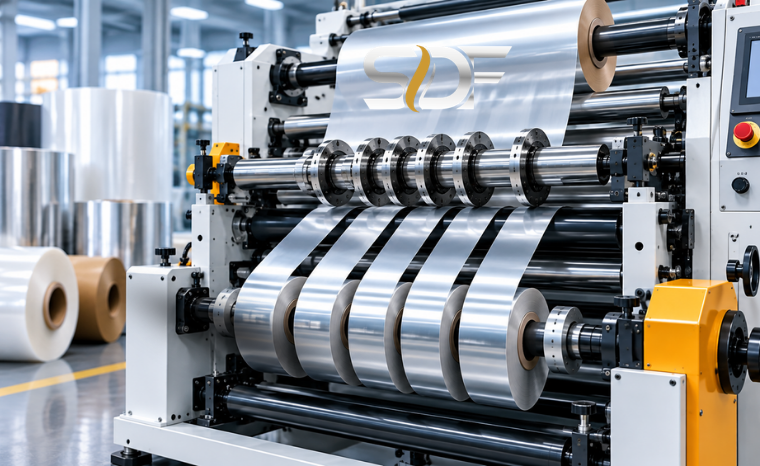
The main use of the slitting machines is to divide large rolls of material into smaller rolls based on the required width. The process begins with loading a roll into the unwind section. It is then guided through the guide rollers and tension control devices to a slitting section. Here, the web is slit into the required widths with precision blades, and the strips are wound onto individual cores. With such a process, manufacturers are able to produce final rolls that can be utilized for printing, packaging, lamination, coating, or any other downstream processes.
Accuracy of cutting is one of the greatest advantages of the slitting machine in modern manufacturing processes. The problem of inaccurate cutting causes such issues as uneven edges, wrong roll sizes, material loss, and complications in further processing of materials. Modern slitting machines have precision blade devices, web guidance, and material tension control systems that provide accuracy of cutting. Helps manufacturers obtain consistent dimensions, even on large quantities of material.
In order to meet the different requirements of the industries, slitting technology can be divided into various types. Slitting machines are commonly used in the flexible packaging sector to slice through a variety of materials including BOPP, PET, PE, CPP, and multi-layer laminated films. Most of these materials are then rolled down to a narrower format for printing or pouch making. Slitting accuracy is especially critical since roll width tolerances can impact print registration, package size, and downstream equipment efficiency.
The aluminium foil industry also uses the precision slitting system. To ensure good aluminum foil production properties, it is important to maintain proper foil tension throughout the production process, as aluminum foil is very thin and sensitive to mechanical stress. It is possible to control the tension when cutting the foil into determined widths with a suitable slitting machine. This helps minimize wrinkles, edge damage, and winding issues, leading to easier rolls to handle and process.
Another critical application is paper converting. Large paper rolls are reduced in size to smaller rolls for printing, labelling, wrapping, and industrial uses. In the course of this process, proper cutting and rewinding are essential to maintain the quality of the finished product. Today, the slitting machines can be adjusted to run various grades and sizes of paper rolls, and thus have become applicable to various kinds of paper processing applications.
The efficient slitting technology is also important for the adhesive tape manufacturing industry. Adhesive-coated materials must be rolled into smaller sizes for packaging, stationery, and industrial and specialty uses, especially when dealing with jumbo rolls. The quality of the slitting machine will directly affect the finished tape product’s appearance and usability; a good slitting machine can be used to achieve clean cutting and ensure the uniformity of the roll. Loose rolls, telescoping, and uneven edges are other issues that can be avoided by controlled winding.
Consistent cutting performance is largely dependent on the tension control. The web needs to be stable during the slitting operation to have a constant tension level. Too much tension may stretch or damage delicate materials; too little may cause rolls to be loose or uneven. To meet production requirements, modern slitting machines are equipped with automatic tension-control systems that allow the machine to adjust the material handling conditions. This helps to maintain stable web movement and helps to achieve good quality finished rolls.
The modern slitting machines are also enhanced by automation features. These features, such as PLC-based controls, touchscreen interfaces, automatic web guiding, programmable production settings, and digital monitoring systems, enable operators to operate the process more efficiently. Automated systems can minimize manual adjustments and increase repeatability between production batches. It can be beneficial to manufacturers who work with several materials, roll widths, or customer requirements.
Another benefit of the advanced slitting technology is that it saves material. When the cutting accuracy is not good, it will lead to rejected rolls and waste of valuable raw materials. Optimized tension control and precision blades ensure that material is maximized. Better control over production can reduce the downtime caused by poor quality of the roll, thereby allowing smooth production.
Some of the important factors that need to be considered while selecting a slitting machine include the type of material, maximum width of the web, minimum width for the slit, speed of operation, diameter of the roll, blade configuration, control system, and automation level. The machine must be capable enough to accommodate the materials and production. Other factors such as maintenance needs, availability of spare parts, technical support, and durability should also be taken into account prior to investment.
With the continuous advancement of manufacturing automation and precision manufacturing, the slitting technology is also undergoing changes. The current machinery has a more advanced system of control, advanced safety measures, real-time monitoring capabilities, and the capability of efficient material handling. All of this allows the manufacturers to increase their productivity levels and maintain the required standards of quality in the challenging industrial environment.
On the whole, slitting machines are of great importance for the manufacturing operations of those companies which require high levels of precision in cutting and continuous production of rolls. These machines can be applied in various sectors because of their capability of processing paper, film, aluminium foil, laminates, adhesives, etc. The modern slitting machines have many advantages that allow decreasing material losses, increasing the efficiency of production, and ensuring accurate cutting results throughout the manufacturing process.