

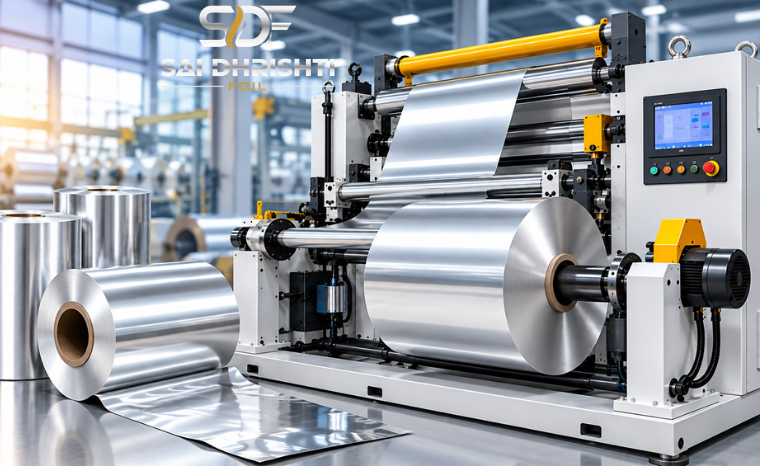
Aluminium foil has many application areas in the food packaging industry, pharmaceuticals, insulation, electrical products, household, and a number of industrial areas. Because of its thinness, lightness, and sensitivity to tension, aluminium foil demands careful handling during the processing of the roll. Wrinkles, telescoping, uneven tension, or inconsistencies in winding or alignment can result in poor roll formation and edge damage. An aluminium foil winding machine is able to solve these problems by ensuring controlled winding and precise roll formation. This equipment assists manufacturers in manufacturing uniform rolls with a precision control system and modern automation system, and helps to improve productivity and material utilization.
Aluminium Foil Winding Machine is a kind of industrial equipment that is able to wind aluminium foil into specified width, length, and diameter rolls of finished aluminium foil. The machine removes foil from a parent roll or processing line and deposits it on a core or winding shaft. Various mechanical and electronic systems are used to control these factors during this process: web tension, web alignment, web winding speed, and roll pressure. These controls are significant since aluminium foil will be easily damaged in the event it is subjected to excessive mechanical stress. Well-designed winding equipment keeps the physical quality and appearance of the foil during production.
One of the most important functions of modern winding technology is roll control. For high-speed production, the foil should be properly aligned to be wound. If the web deviates from the intended direction, the resulting roll could have irregular outer edges or telescoping. The material flow in the advanced aluminium foil winding machine system is stable thanks to its web guiding and tension-control mechanisms. The above-discussed technology allows manufacturers to produce rolls that are small in size, even, and easy to transport, store, and process further in the manufacturing process.
Usually, the beginning of the processing begins with mounting the parent foil roll on the unwinding section. The foil is then passed through a series of rollers and control devices to make its way to the winding area. The machine controls the tension of the foil being fed towards the winding shaft. During the winding process, the control system monitors and regulates the speed and tension of the material while adjusting them to compensate for the varying roll diameter. When the desired length or diameter is reached, the winding cycle can be finished, and the roll can be taken off the machine for inspection or additional winding.
The machine configuration has to be taken into consideration based on the requirements of the industries of aluminium foil rolls. The food packaging manufacturers might need a particular wound configuration and width of rolls for additional processing into home or commercial packaging materials. In pharmaceutical packaging, the quality of the foil is required to be carefully controlled since it can be employed as part of protective packaging structures. Special dimensions for the roll and controlled application of winding conditions for electrical or industrial applications can also be required. These various production requirements can be achieved by setting up an aluminium foil winding machine.
New machines have more and more automation functions; these enhance the control of the machines. PLC-based control systems enable operators to operate critical functions from a central location. Information on speed, tension, roll diameter, and other operating parameters can be given on touchscreen panels. Automatic tension adjustment can be helpful in maintaining the same tension during winding a roll as it changes size. The web guiding systems can also assist in maintaining the foil’s central position during operation. These technologies can together help to minimize manual involvement and provide more uniform production.
Another major advantage of an aluminium foil winding machine is the enhanced utilization of materials. Aluminium foil is a valuable material, so waste is unnecessary, which would drive up manufacturing costs. If you do not get a good wind, you may end up with wrinkled, damaged edges, an improperly wound section, or an unusable roll. These can be avoided by controlling the tension and alignment precisely. Higher quality winding will also be beneficial for other processes such as slitting, printing, laminating, and packaging.
Growth in flexible packaging and other industrial applications is driving demand for efficient foil processing equipment. Aluminium foil is still being used for food and pharmaceutical packaging due to its barrier and protective properties. Manufacturers are thus seeking equipment that will efficiently process foil and provide consistent roll quality. Concurrently, the increasing need to improve the speed of production, to minimize manual handling, and to ensure repeatable operating conditions makes automation more and more relevant to businesses.
Another factor that influences the long-term performance of an aluminium foil winding machine is maintenance. Rollers, bearings, web guiding systems, tension control, and sensors should be checked regularly based on the manufacturer’s specifications for the equipment. This ensures that production is not interrupted by unforeseen problems and assures winding accuracy. Training of the operators is also critical, since the quality of the finished rolls can be greatly affected by the settings given to the machine.
The manufacturers need to consider the following factors while selecting the aluminium foil winding machine: foil thickness, maximum web width, winding speed, roll diameter, core size, tension control, automation level, and production capacity. The machine should be designed to process the foil grades and rolls that are being processed. Technical support, availability of spare parts, installation and maintenance services are also important factors to consider when choosing equipment suppliers.
In general, the aluminium foil winding machine offers the manufacturer better control over one of the most sensitive steps of the foil manufacturing process. The uniform and reliable finished rolls are achieved by accurate tension management, web alignment, speed control, and consistent winding to provide a uniform and reliable product. Advanced winding technology will continue to be a vital component in efficient roll production as industries will continue to need more quality aluminium foil for use in packaging, pharmaceutical, electrical, and industrial applications. The use of appropriate equipment and good process control can enhance productivity, minimize material waste, and deliver higher-quality rolls for demanding applications.