

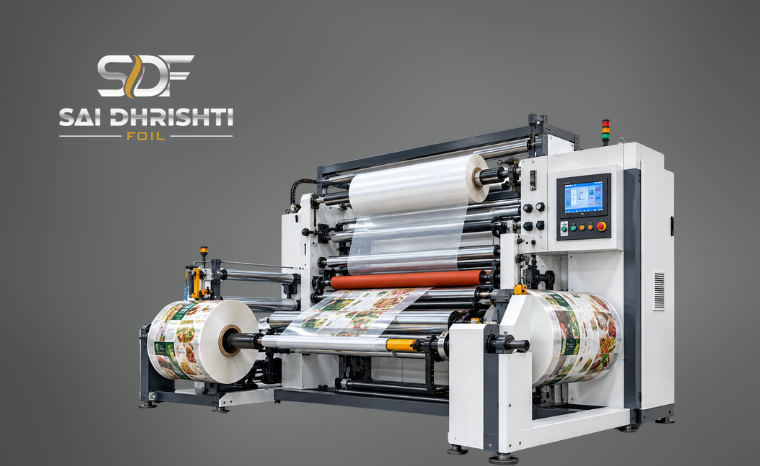
In today’s industrial production, seeing two or more materials being combined to make a durable product is a must when making high-performance packaging and industrial products. Materials like plastic films, paper, aluminium foil, and special substrates frequently have to be joined to provide a desired strength, protection, and function. This is achieved by using lamination machines that apply pressure, adhesive, heat, or a combination of the three to join multiple layers together. They are very popular for flexible packaging, printing applications, pharmaceutical packaging systems, consumer goods, and other industrial applications where it is important to ensure good bonding between layers.
Lamination machines are mainly used to join two or more substrates together to form a strong, uniform bond. Different properties of the final material can come from each layer. One layer can give mechanical strength, another can be moisture- or oxygen-resistant, or another can have a good surface for the printed layer. These materials can be used together, creating packaging structures with better performance than the individual materials. Strong bonding is critical in particular, as weak or irregular places can impact the long life and visual style of the completed product.
The lamination process starts by feeding the selected substrates into the machine via controlled rollers. In one of the materials, an adhesive can be applied by a precision coating system, depending on the machine configuration. The second substrate is subsequently placed in contact with the surface coated with the adhesive. The layers are joined together, and contact across the web is ensured with the pressure rollers. The bonded material can be sent through a drying/curing area or not, depending on the lamination technology, before it is rewound into a finished roll. Precise control in the entire process ensures uniform bonding across the width of the material.
Various types of lamination machines are available to suit the particular requirements of production. Dry Lamination is a process that applies an adhesive to one substrate that is then dried and bonded to another. They are very commonly used in flexible packaging structures. Solventless lamination machines are equipped with specially formulated adhesives that do not contain conventional solvents and can provide an efficient solution for many packaging applications. Thermal lamination systems apply heat to laminate material and are widely employed to laminate printed products, documents, labels, and protective surfaces. The choice of technology is dependent on the materials, adhesive requirements, production speed, and specifications of the final product.
In addition to being one of the most critical uses of lamination machines, flexible packaging plays a vital role in the packaging industry. Food pouches and snack packaging, sachets, stand-up bags, frozen food packs, and other flexible packaging foods frequently require several layers of materials to achieve the desired combination of strength and barrier properties. A laminated structure can be used for moisture, oxygen, light, and external handling protection of the packaged product. Meanwhile, the outer surface can serve as an effective base for high-quality printing and branding. This bonding will provide good adhesion of these layers during converting, filling, transport, and storage.
For the pharmaceutical industry, advanced lamination technology is an important technology for protective packaging. Materials that have high barrier properties are needed to prevent contamination, light, and moisture from affecting pharmaceutical products. Laminated structures can be formed of aluminium foil and polymer films, paper and other substrates to deliver desired performance. Consistency in bonding is crucial, since the packaging needs to have the same protective functions throughout the product’s shelf life.
The modern lamination machines are fitted with sophisticated control systems which enhance the accuracy and efficiency of production. Common features of today’s equipment are PLC-based automation, touch-screen interfaces, automatic tension control, precision adhesive application, web guiding, and digital monitoring systems. The movement of the web may be unstable depending upon the tension control and causes wrinkles, misalignment, or uneven bonding. Automated systems can be used to help maintain consistent operating conditions and to minimize the need for regular manual adjustments.
One of the other benefits of the high-tech lamination press is better material utilization. Excessive use of adhesive can be avoided by making sure to apply the adhesive precisely, and an accurately aligned web will minimise the chances of faulty material. Smooth machine performance can also help to reduce production downtime and boost efficiency. These enhancements can help manufacturers who handle high quantities of packaging materials to achieve more consistent production and reduced operating costs.
Lamination technology is adapting to the growing importance of sustainability in the packaging industry. Manufacturers are seeking recyclable substrates, solvent-free adhesives, more efficient energy drying, or better material structure. These developments can be achieved with a modern lamination machine, which can deliver precise process control and fast adhesive application. Lamination machinery can serve as a worthwhile element in the production process, helping to reduce wastage and make more environmentally conscious decisions, as organizations move forward.
Factors such as substrate compatibility, machine speeds, maximum web width, drying requirements, automation options, tension, and capacity should all be considered when selecting lamination machinery. It should also be analyzed what the maintenance needs and after-sales technical support are before investing. The ability of a machine to meet the specific production process over its working life can result in a higher level of reliability and performance.
To conclude, lamination machines have significant importance in the production of strong and durable multi-layered products. Such machines are capable of blending different types of materials with great precision, which is highly useful in packaging, pharmaceuticals, printing, consumer goods, and industrial sectors. Using modern lamination machines equipped with automated systems and environmentally friendly lamination technology will enable manufacturers to ensure that they have excellent bonding between layers, efficiency, optimal utilization of materials, and high-quality products.