

Aluminium foil is a lightweight, versatile material used in a variety of applications, including packaging, pharmaceuticals, food, electrical, and industrial uses. Foil is thin and fragile; however, during production, it demands precision and control of its tension. A slight wrinkle or scratch, uneven edges, twists and turns in the feed or loose winding can influence the quality of the finished roll. This is the reason why it becomes important for companies looking for solutions for efficient foil processing to choose a competent Foil Winding Machine Manufacturer.
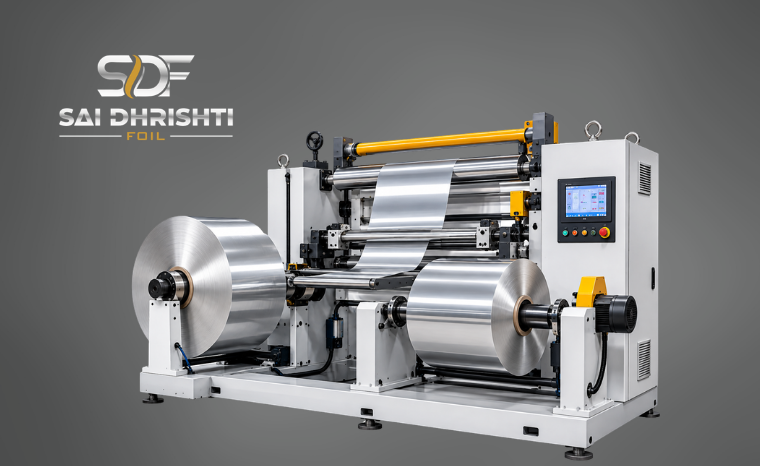
A foil winding machine is a machine used to wind aluminium foil or other thin web items into regular rolls with controlled tension and perfect roll formation. The foil is fed from an unwinding section to the machine and is wound onto a core or winding shaft. Here, the system is responsible for regulating the web tension, alignment, winding speed and roll formation. Manufacturers can achieve smooth rolls with appropriate compactness that are suitable for further processing, storage, and transportation by proper control of these parameters.
Control of tension is one of the most crucial parts of foil winding. Excessive tension causes aluminium foil to easily stretch, crease or break. However, if there are too few turns, the rolls may be loose or uneven. Advanced tension-control systems are, however, used in modern machines to guarantee stable web movement during the winding process. A professional Foil Winding Machine Manufacturer can provide the customer with the design of the necessary equipment, which has a suitable tension management technology, based on the customer’s foil thickness, width, required winding diameter and production speed.
The winding process typically starts with loading the parent foil roll on the unwinding unit. The foil then proceeds to pass through guide rollers and web alignment systems, and reaches the winding section. The machine smoothly manages the material and winds it around the core. Important operating parameters can be monitored during production by sensors and automatic controls. When the desired roll diameter or length is achieved, the roll can be removed and is ready for inspection, packaging or additional converting.
Today’s foil winding machine has a number of features that enhance the production efficiency and the quality of the roll. Web guiding by automation guarantees proper foil alignment when winding takes place, while the use of programmable controls allows the operator to set production specifications. Variable speed drives can ensure smooth starting and stopping, hence avoiding any sudden changes in tension. A touchscreen interface can also help to keep track of machine performance and to fine-tune machine settings for various production needs.
The right Foil Winding Machine Manufacturer should be able to offer answers to various industrial uses. In the food processing industry, aluminium foil is the material that is most often used to make rolls that are utilised for the domestic and commercial packaging industry. High-quality foil is used for blister packaging and other protective uses when material consistency is significant, by pharmaceutical companies. Aluminium foil is further applied in various specialty industrial applications, heat exchangers, electrical products, and insulation. The desired roll dimensions, winding requirements and handling characteristics may vary from sector to sector.
One of the key advantages of the modern foil winding technique is the increased material efficiency. If there are any bad winding situations, they can lead to wrinkles, telescoping, damage to the edges, or unusable sections of foil. This type of issues leads to material wastage and increased production costs. Precision winding systems can help to reduce these problems by ensuring that the web is wound under controlled tension and that it is aligned correctly. This ensures that manufacturers obtain better quality rolls and achieve effective use of raw materials.
The introduction of automation technology is altering the manner in which foil processing plants are operated. Some advanced winders can have programmable controls, tension controls, web sensing, digital displays, and PLC controls. This eliminates the need for manual adjustment of production processes. Automation can also enhance production speed and reduce downtime between various production batches for large-scale manufacturing facilities.
There are various technical and commercial aspects to take into account when choosing a Foil Winding Machine Manufacturer. The machine capacity, the thickness range of foils to be processed, the maximum web width, the winding diameter, the running speed, the tension-control technology, the degree of automation and the core specifications should be matched to the requirements for production. Manufacturers’ engineering experience and ability to provide machine customisation can also be significant, particularly if processing specialised foil grades or unusual roll sizes.
Another aspect that shouldn’t be neglected is the after-sales service. To avoid unwanted stoppages in production, regular maintenance and timely technical assistance can be very helpful. Long term reliability of equipment can be provided through the availability of replacement components, operator training, installation assistance and troubleshooting support. This is because working with an experienced manufacturer can offer value beyond the initial machine purchase.
The foil processing industry is becoming increasingly automated, strictly controlled for quality and more efficient in production. As a result, manufacturers are increasingly seeking winding equipment that can provide them with consistent rolls, while at the same time minimising waste and energy consumption. In future foil-winding operations, smart monitoring technology and better control systems are anticipated to have a more significant role.
To summarise, choosing the appropriate Foil Winding Machine Manufacturer will increase the effectiveness of foil handling and manufacturing. Advanced winding technology offers superior tension control, alignment, roll formation and material consumption. The demand for aluminium foil has persisted in the packaging, pharmaceutical, food and other industrial markets, and efficient winding equipment will continue to be a vital component of the modern foil converting process.