

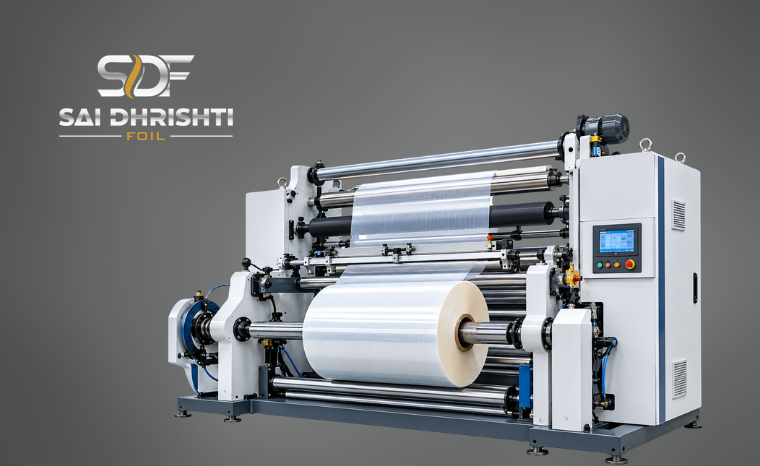
In modern roll-to-roll manufacturing, consistent material quality is essential to ensure production efficiency and customer satisfaction. Unfortunately, various imperfections can be observed when printing, coating, laminating, or converting materials, including films, paper, foil, laminates, and flexible packaging substrates, which can be produced in large rolls. A doctoring rewinding system helps manufacturers trace faulty sections, cut away unwanted material, and produce finished rolls that meet specific quality standards. Thus, doctoring rewinding machine manufacturers are crucial to providing machines that aid in quality control, precise rewinding, and efficient material management.
A doctoring rewinding machine is used to check and rewind rolls and to detect faults in the material. The defects can range from wrinkles, unequal winding, scratches, splice problems, coating problems, printing problems, and more. The machine does not return the whole roll to be processed or reject the whole roll; it gives the chance to investigate the material and cut off any faulty parts. This can minimize material waste and enhance the convenience of finished rolls.
The basic operation starts with mounting the parent roll onto the unwinding section. The material is then guided and inspected through the material and re-wrapped around another core. In this process, defects may be detected by the operators and/or integrated inspection systems. If a fault is found in a faulty part, the machine can be stopped or controlled to remove the bad section before it is possible to resume rewinding. The use of adequate tension throughout the rolling process results in an even, compact, constant-diameter roll that is appropriate for the next stage of the manufacturing process.
The great benefit of collaborating with informed Doctoring Rewinding Device Manufacturers is that they are equipped with equipment that is created to meet certain manufacturing needs. Operating parameters are different for different materials. Depending on the thickness of the film, it may need more delicate control of tension, whereas thicker paper or foil will need a more robust mechanical system. Manufacturers are thus able to choose machines with respect to web width, roll diameter, material thickness, operational speed, winding requirements, as well as inspection requirements.
There are various technologies involved in today’s doctoring rewinding machines that help in further enhancing productivity and roll quality. An automatic web guiding system is used to ensure the correct material alignment during rewinding, and a tension control system is used to avoid free or over-tightened rolls. Easier to set and monitor production parameters with PLC-based controls and touch interfaces. In addition, some of the advanced systems can incorporate web inspection technology, enabling manufacturers to detect surface or printing defects more effectively.
Doctoring rewinding technology is used in a wide variety of applications, one of the largest being the flexible packaging industry. The printed films and laminated structures need to have strict visual and dimensional quality requirements. A minor defect in printing, a wrinkle, or a bonding problem can impact the use of the product. A doctoring rewinding machine can be used to check the condition of the rolls before they go into other processes like slitting, making pouches, or packaging. This extra quality control measure can help to avoid defective material from entering any further stages of production.
This is also equipment that is advantageous for the paper and printing industry. Paper rolls can experience certain faults while being printed, coated, or handled. Doctoring and rewinding enable the manufacturers to examine the material and roll a cleaner finished roll. Aluminium foil and specialty film manufacturers can also benefit from such machines when they are manipulating thin film materials and need to keep tight control on the winding tension. Rewinding systems can be useful for a wide variety of roll-based manufacturing processes because of their ability to process different materials.
Efficiency is another advantage that comes with this. Manual methods of inspection and rewinding require much effort and may cause defects in the roll. Automated or semi-automated methods reduce the amount of additional effort that is required and allow for the processing of larger quantities of production. It is also possible for manufacturers to reduce waste by eliminating defective portions of the material. This can help to reduce production expenses and improve resource management.
To assess Doctoring Rewinding Machine Manufacturers, companies need to check the construction of a machine, maximum web width, rewinding speed, roll diameter capacity, tension-control system, inspection options, automation level, and compatibility with existing production equipment. After-sales support is also very important. The availability of spare parts, technical assistance, maintenance, and operator training can contribute to machine performance long-term.
The needs of industry are also headed into more automation and digital monitoring. There is a growing demand from manufacturers for equipment to deliver higher levels of process visibility, minimise human errors and connect with other production equipment. These can be helped by advanced doctoring rewinders which offer programmable controls, digital monitoring, automatic web guiding and enhanced inspection features. These technologies continue to be valuable as manufacturers strive to minimize waste and quality becomes a priority.
Quality Doctoring Rewinding Machine Manufacturers can directly affect the production efficiency and finished-roll quality. A well-designed machine can be used to help inspect materials, cut out bad sections, maintain proper tension, and ensure uniform rolls for additional processing. This is especially crucial in industries that are very sensitive to the consistency of materials and surface quality.
In general, doctoring rewind technology offers an efficient way of quality control and roll preparation. The inspection, defect removal, and precision rewinding can be achieved in a single production process, which can help improve material utilization and eliminate non-value-added waste. Moving forward, Doctoring Rewinding Machine Manufacturers will be vital in helping the packaging industry, printing industry, paper industry, foil industry, and film industry have an efficient way to process their rolls.