

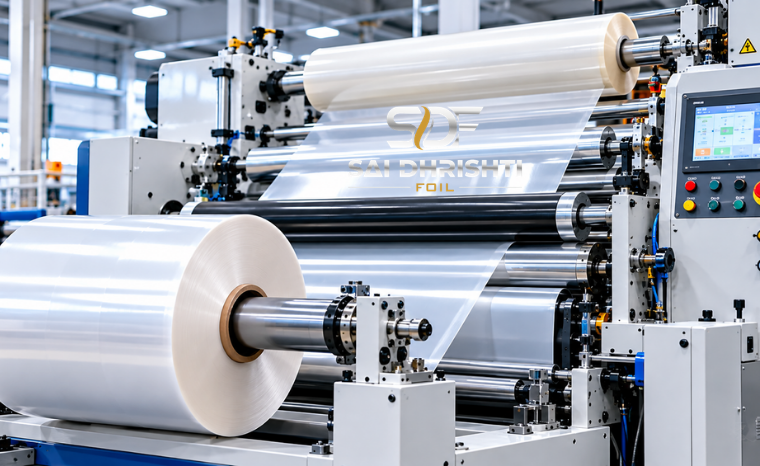
Versatility in manufacturing, using different materials to enhance strength, durability, and performance, is a fundamental requirement today. Materials must withstand handling, moisture, and environmental exposure across flexible packaging, printing, pharmaceuticals, electronics, and consumer goods. Lamination machines help manufacturers meet these requirements by attaching 2 or more layers of material to form a functional structure. Modern lamination technology enables a wide variety of industrial applications with efficient production and product quality through automation and process control.
A lamination machine is a machine that is used to bond various materials, including plastic films, paper, aluminium foil, fabrics and specialty substrates, using adhesive, heat, pressure, or both. Specific properties can be added to the finished product by each layer. One of them can be used for mechanical strength, one for moisture resistance, and one for a printable surface, for instance. These properties can be combined to make materials that outperform any single one of the layers alone.
Typically, the lamination process starts with the transfer of the initial material to an unwinding part of the machinery. Either one of the substrates is coated with an adhesive in a controlled manner, depending on the machine design. A second material is then brought into contact with the coated surface. The layers are pressure bonded evenly and can be completed with drying/curing systems. The laminated material is then rewound in rolls or ready for subsequent processing such as slitting, printing, pouch manufacturing, packaging, etc.
One of the most important applications of lamination technology is flexible packaging. Packaging for food products, snacks, frozen products, some personal care items and household products can be moisture-, oxygen-, and external contaminant resistant. These can be achieved by using combinations of different films and barrier materials to laminate them. They can also help to protect products while providing appealing printing and branding. A high-quality lamination machine plays an important role in ensuring manufacturers have uniform packaging materials that have consistent appearance and reliable bonding.
Laminated materials are also used in protective packaging in the pharmaceutical industry. Some medicines and health products are uniquely packaged to protect them from moisture, light and other environmental factors. Specialised packaging structures can be achieved by using aluminium foil, polymer films and paper together. It is extremely important to apply the glue correctly and to bond it properly, as the defect may cause a poor-quality package and poor performance. For the manufacturer, suitable lamination equipment can ensure the consistency of the process in production.
Lamination is used in the printing and publishing industries to protect the materials and for appearance. Printed sheets, labels, book covers, brochures, posters and promotional items can be laminated for enhanced scratch, moisture and wear resistance. The manufacturers can apply them in a glossy, matte or specialty finish to give the desired appearance. Printed films and decorative films for furniture surfaces and interior uses are also suitable for industrial lamination systems.
The contemporary lamination machines have a number of features that enhance the efficiency of production and quality of materials. Maintaining stable operating conditions is provided through PLC-based automation, touchscreen controls, automatic tension regulation, web-guiding systems and precision adhesive application. For thin films, it is especially crucial to ensure proper tension control to prevent the film from being stretched or damaged by excessive tension, and to avoid wrinkles or misalignment due to insufficient tension. These can be overcome by having automated systems.
One additional advantage of the superior laminating technology is that there is better utilisation of the materials. Poor bonding, inconsistent adhesive coating and alignment can result in rejected product and waste of material. Modern control systems contribute to controlling coating levels and web movement to provide a stable web and minimise production defects. Efficient operation can also reduce downtime and boost output, which can help manufacturers to handle large production orders more efficiently.
In industrial manufacturing, sustainability is becoming a more and more important issue. To lessen the impact on the environment, many companies are investigating recyclable packaging structures, solventless adhesives and more efficient production techniques. In some applications, solventless lamination may be appropriate since it does not use conventional solvent-based adhesive systems. The correct technology is dependent on the substrate, adhesive formulation, barrier properties and end use, however. These factors should be examined by manufacturers before making decisions for sustainable production goals when choosing equipment.
The factors that should be taken into account when selecting lamination machines are material compatibility, maximum web width, the speed at which the machine can be expected to operate, the type of adhesive used, drying or curing requirements, level of automation, and roll handling capacity. Other factors such as maintenance requirements and technical support should also be considered. Choosing the right equipment for the specific application ensures manufacturers can operate reliably, bond properly and produce more consistent, long-lasting results.
In summary, laminating machines are useful machines in various industries, especially in industries that make use of multilayer materials and applications. They can handle several different substrates; that’s why they play an important role in such processes as packaging, pharmaceuticals, printing, electronics, and others. Lamination systems used today will still be very important for improving the protection of products, reducing wastage, and maintaining quality in production as the industry becomes more automated and materials become more advanced.