

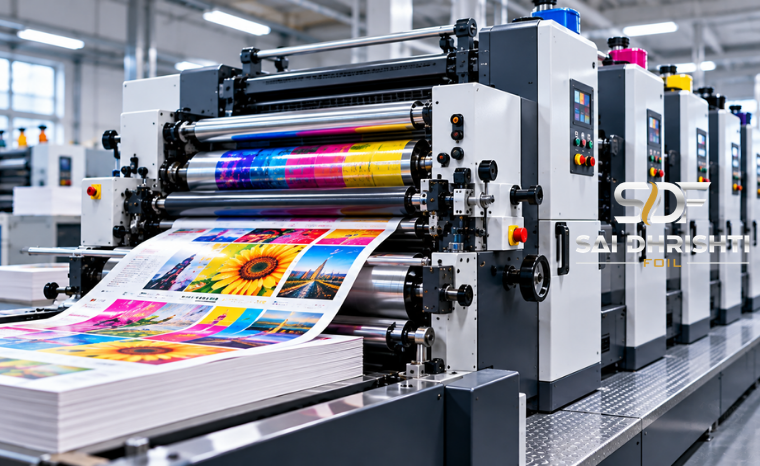
Customer demands and the current competitive printing market demand precise, consistent, and well-made prints for businesses. Whether it’s packaging, publishing or advertising to commercial printing, the quality of print products is a critical part of product presentation and brand recognition. The printing press machine enables businesses to reproduce clear text, detailed graphics, and consistent colors on a variety of materials. Today’s printing technology is more advanced, making use of automation and printing technology, which helps speed up the printing process, improve accuracy, and resource utilization.
Printing Press Machine: Industrial machines used to transfer text, pictures, and designs to materials like paper, cardboard, labels, film, and other appropriate materials. The printing process may involve ink, pressure, plates, cylinders, or digital imaging systems, depending on the printing method used. They can be configured in various ways to suit the needs of small printing businesses, commercial printing businesses, packaging manufacturers, and large industrial production facilities.
The consistent print quality is one of the main benefits of a printing press machine. All printed sheets or packages in commercial production should have the same color accuracy, alignment, and clarity. Today, controlled ink delivery, precision material feeders, and sophisticated registration systems help to reduce printing variations. These features are highly beneficial for companies that generate a vast amount of brochures, catalogs, product labels, packaging, and promotional products.
There are various kinds of printing press machines available for specific applications. For a variety of commercial printed materials, such as books, magazines, brochures, and newspapers, offset printing will be used widely. These are good for repetitive tasks in which a high volume of work is performed, and there is a need for consistent results. Flexographic printing machines are widely used in flexible packaging, labels, corrugated boxes, and paper bags. Rotogravure printing machines are intended for high-volume printing, in which the image details and color consistency are crucial, especially in flexible packaging. Digital printing machines work well for short print runs, customised materials, and jobs that demand frequent changes without the traditional printing plate.
Modern printing technology is widely used in the packaging industry. Product packaging should convey information and be appealing to the brand. Accurate text, bright graphics, and uniform colors are frequently needed in food packaging, pharmaceutical labels, cosmetic cartons, shopping bags, product packaging, and the list goes on. The printing press machine is equipment that meets the above requirements and is suitable for packaging manufacturers for efficient production. Printing technology is determined by the type of printing substrate, complexity of the design, order size, and the finish desired.
Modern printing equipment has been efficiently improved by automation. There are many new machines with PLC control systems, touch screen displays, automatic registration, and programmable production setting features. Such systems can assist operators in making more efficient machine adjustments, thereby minimizing the need for repeated manual adjustments. Automated monitoring can also identify an operating issue before it has a negative effect on a large quantity of printed product. This will help the businesses to have a better consistency in their workflows and avoid unnecessary production delays.
Another key factor to ensure high-quality prints is ink management. The type of ink used should be chosen based on the material, printing process, drying process, and the purpose of the printed final product. The controlled ink application provides even ink coverage and prevents common ink problems like excessive ink usage, uneven colour, and smudging. Drying and curing systems are also of great importance as the printed material should be made ready for subsequent handling, finishing or packing operations.
A printing press machine can also help in improving the productivity and material waste management of a business if it gets a high-quality machine. Registration, material feeding, and ink transfer are done accurately, stably, and reliably to decrease the number of misprints and rejected sheets. Easier and automated setup can minimize downtime between jobs. These advantages become very significant when it comes to printing companies that manage a number of orders that contain various designs, substrates, and production needs.
The following aspects are considered when choosing a printing press machine: Printing technology, speed of the printing process, the possibility of printing in the widest width, compatibility of substrates, colour capacity, automation, and maintenance. Additional factors you should take into account include floor space, operator training, spare parts, and technical support. Selecting equipment that corresponds to the needs for production and use of the business can be a way to guarantee the long-term performance of the equipment.
The printing industry is increasingly conscious of the importance of sustainability. Manufacturers are looking to design efficient ink formulations, recyclable substrates, minimise setup waste, and look into technologies that can manage energy usage. These efforts can be aided by using modern printing equipment that offers accurate controls for minimizing the amount of unnecessary material thrown away and for product consistency. Inks and substrates should also be chosen to meet the needs and environmental considerations of the intended use.
In conclusion, a printing press machine is a valuable asset for any business that wants to achieve high-quality prints and productivity. Whether it’s commercial or industrial packaging, print accuracy, consistency, and high-volume manufacturing are supported by the right equipment. With the right technology and operational processes, printing companies can ensure high-quality prints, lower waste, and customer satisfaction in today’s markets.