It is equally important to have secure transportation of products as efficient manufacturing in the present times of fast-paced manufacturing, storage, and logistics. Damage to products can be caused by transport, which may lead to customer dissatisfaction, delayed supply chains, and loss of revenue. This is where the use of a stretch wrapping machine becomes vital. The stretch wrapping machine is designed to wrap the products and pallet loads with stretch film for greater load stability and protection of products from any kind of outside damage, as well as increased efficiency in packaging operations.
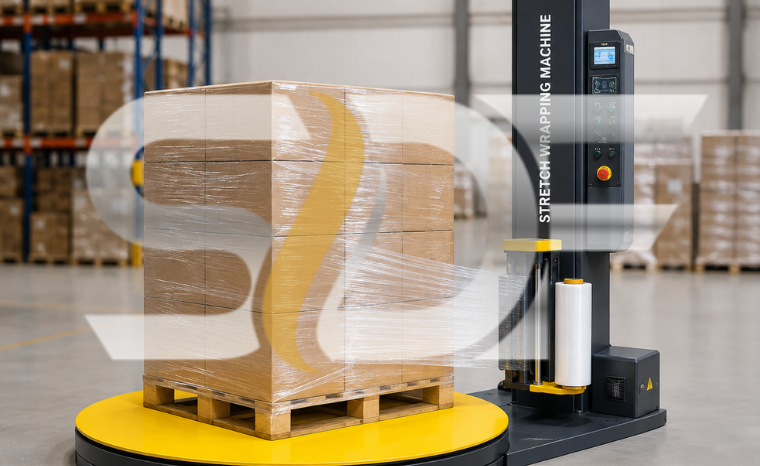
A stretch wrapping machine is a kind of automatic or semi-automatic machine that uses a stretch film to tightly wrap a product or pallet. While being handled, stored and transported, the stretch film imparts tension to the load, thereby keeping it together so that it does not move. Automated machinery ensures an even coating of the film, tension control, and uniform patterns of wrapping. Not only does this ensure that the goods are safer, but it also ensures that there is less wastage of film and labour. It can be utilised in small manufacturing units or big distribution centres, along with providing reliable performance for high-volume packaging.
One of the main reasons that industries invest in a stretch wrapping machine is that it helps in enhancing the stability of the load. Pallets are vulnerable to vibrations, abrupt motion and stacking pressures during transportation. If not properly wrapped, products may shift or collapse, causing the merchandise to become damaged. A professionally wrapped pallet will stay stable during the shipping process and will help prevent loss of product. Warehouse safety is enhanced by stable loads, which helps to minimise pallet tipping during forklift loading or unloading as well as when stored on pallets.
The modern stretch wrapping machine system is used across a variety of industries including food and beverage, pharmaceuticals, construction materials, consumer goods, chemicals, electronics and logistics. These machines are used in the food manufacturing industry to seal cartons, bottled goods and packaged goods prior to shipping. Stretch wrapping is used in the pharmaceutical industry to safeguard fragile medical goods from dust and moisture. Stretch wrapping is used for heavy pallet loads to make sure they stabilise for domestic and international transport by manufacturers of tiles, paper rolls, cement products and industrial components. These machines can be used in almost any industrial application where secure product movements are needed.
The working process of a stretch wrapping machine is very simple, but highly efficient. A turntable or conveyor system is used to load products or palletised loads onto it. The stretch film is fixed to the load, and then the machine evenly wraps the stretch film around the products as the pallet rotates. Advanced tension control systems provide constant film tension, which guarantees load stability without harming the products. After a predetermined number of wraps, the film is automatically cut, and the pallet is ready for shipping. This automated process enhances packaging speed and assures uniformity of quality throughout each load.
Today’s stretch wrapping machine has become an intelligent packaging solution thanks to the aid of technology. Modern equipment is equipped with PLC control systems, touch screen display and control units, adjustable wrapping programs, automatic film cutting, variable turntable speed and programmable film tension control. Some advanced machines are equipped with a conveyor system and robotic packaging line so that it can be fully automated production with low labour intake. The innovations are helping manufacturers to become more efficient, reduce packaging costs lower and reduce machine downtime.
The packaging industry is constantly changing, and there is increasing demand for automation and sustainability. As more and more packaging equipment becomes smart, businesses are able to benefit from optimised film use, reduced energy consumption, and environmentally friendly packaging materials. Industry trends are showing increased use of IoT-enabled monitoring systems, predictive maintenance technology and recyclable stretch films. With e-commerce, export business and warehouse automation still on the rise, the market for advanced stretch wrapping machine solutions is projected to steadily increase in global markets.
The advantages of investing in a modern stretch wrapping machine for the business are given below. The following are some long-term business benefits of investing in a modern stretch wrapping machine. It helps in achieving consistency in packaging, boosts packaging production rate, reduces the need for human labour, prevents product damage in transit, and cuts packaging material usage by precise film control. Improved load stability also contributes to warehouse safety standards, the efficiency of the warehouse, and the cost of doing business. The benefits of these directly impact customer satisfaction and supply chain results.
Businesses must consider production volume, pallet size, automation level, wrapping speed, film material types, maintenance needs and after-sales technical support when choosing a stretch wrapping machine. Equipment matching with production needs will result in maximum productivity and reliability in long-term production operation. A professional machinery vendor will be able to provide technical consultancy, spare parts and maintenance in order to guarantee successful production.
A modern manufacturing company considers a stretch wrapping machine as one of the most significant investments for safe transportation, warehousing and economical packaging. It is essential for different industrial sectors because of numerous advantages that the machine has in terms of load securing, protection of goods during transportation, materials saving and packaging efficiency. Due to the innovative stretch wrapping technology, the company will be able to optimise its production and to stay competitive in the constantly changing global environment.