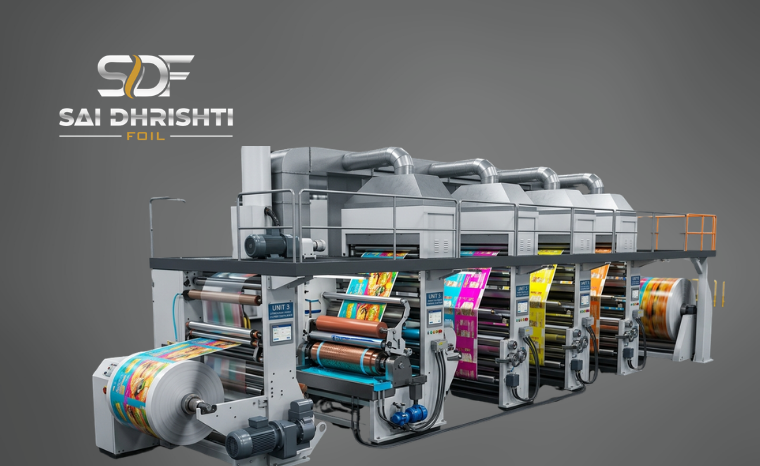
A rotogravure printing machine is an advanced industrial printing system that is widely used in applications of high-quality and high-volume printing. It is especially favored in flexible packaging, labels, decoration, and pharmaceutical packaging, where sharp images, rich colors, and uniformity of printing are crucial. The difference between basic printing systems is that the rotogravure system utilizes engraved cylinders to transfer ink to a printing substrate. This process enables manufacturers to produce detailed graphics and ensure uniformity in the product over long runs.
Intaglio Printing Technology is the principle used by the rotogravure printing machine. A cylindrical printing cylinder with the necessary design is engaged in the printing process. The controlled amount of ink is stored in these engraved areas, called cells. The cylinder is then rotated in an ink reservoir during the printing process, where it picks up ink inside the engraved cells. When the cylinder is engraved, excess ink is removed from the surface with a doctor blade, resulting in ink only in the impression areas. The substrate then slides through the engraved cylinder and an impression roller, where the ink would be transferred accurately onto the substrate.
The main benefit of the Rotogravure Printing Machine is that it can deliver high-volume production with consistent print results. The image is directly imprinted on the printing cylinder, and the machine is capable of creating fine details, gradients, and complex designs with excellent precision. That’s why this rotogravure printing is ideal for brands that demand packaging that looks great and is of high quality. Another major advantage is the ability to achieve consistent color, particularly in scenarios where high volumes of identical designs are to be printed.
An average rotogravure printing machine has a number of key parts that come together to produce accurate printing. The required artwork is transferred onto the printing cylinders, and the ink system provides and controls the printing ink. The ink level on the cylinder is controlled by doctor blades. In order to transfer the image to the substrate, impression rollers are used to apply the required pressure. To prevent the material reaching the next color station before the drying unit, drying units are placed between printing stations. New machines also feature improved automatic registration systems and digital control panels for enhanced accuracy and usability.
As the name implies, the Rotogravure Printing Machine has many applications, especially in industries where high-quality flexible packaging is required. The most frequent application is food packaging, where snack wrappers, pouches, laminated films, and other packages are made using rotogravure technology. The technology enables manufacturers to come up with colorful graphics, product information, logos and promotional designs in great clarity. Gravure printing is also used in the pharmaceutical industry for manufacturing packaging films, labels and protective materials, where accurate and legible printing is required.
The personal care and cosmetic industry is yet another big user of a Rotogravure Printing Machine. Packaging is a crucial part of the brand presentation, and good printing can make products stand out in a busy retail setting. The color depth and image quality obtained by rotogravure enable high-quality packaging design. It is also occasionally employed in decorating laminates, wallpapers, wrapping for gifts and specialty products for industry use.
Modern Rotogravure Printing Machines are becoming more and more automated and advanced controlled. Automatic color registration, electronic tension control, and computerised ink management, touch screen panels, and real-time monitoring are just some of the features that can help manufacturers increase productivity and minimise mistakes. Systems can automatically optimize important production parameters, minimizing operator involvement and helping to ensure print quality. Automation is also beneficial in minimizing material waste and downtime.
The printing industry is also working towards sustainable printing practices. The emphasis is on energy-efficient drying systems, better use of ink, minimising material waste, and better machine design. The market for flexible packaging is still expanding, and an interest in printing technologies that offer both high productivity and effective resource utilization is growing. The developments are encouraging manufacturers to upgrade their production lines with modern Rotogravure Printing Machine systems.
Manufacturers need to take into account various features of a Rotogravure Printing Machine, including those that relate to printing speed, the ability to print multiple colors, the type of substrates the machine can handle, cylinder specifications, drying capacity, automation features, registration accuracy, and maintenance. The right machine must correspond to the production needs and needs of the company. Another thing that should be considered while assessing technical support requirements for the production process includes technical support, availability of spare parts, and training of the operators.
A Rotogravure Printing Machine is a great alternative for all those organizations where accuracy and consistency are paramount, along with the production of high-quality prints in huge numbers. The advanced printing technology used by this machine, which works through the cylinders, ensures that manufacturers can create graphics of a high level of quality. In the age of automation, optimum efficiency and changing printing methods, rotogravure printing continues to be a crucial option for flexible packaging, pharmaceutical, cosmetic, decorative and industrial printing.