

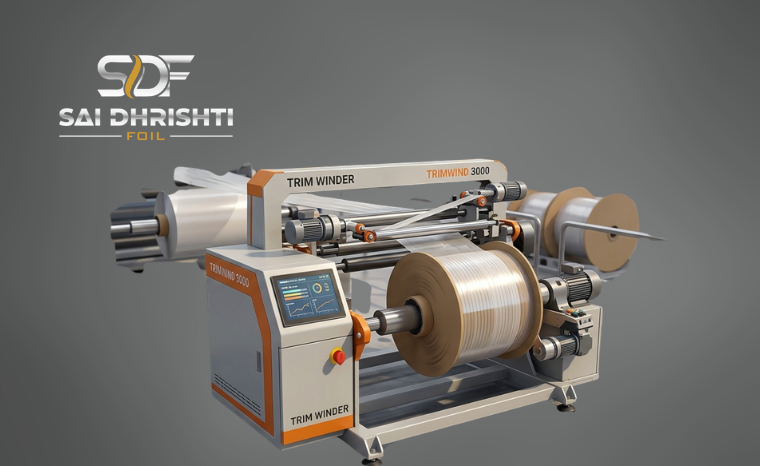
Good waste management systems are very important in the current production and conversion procedures because they help improve the productivity and cleanliness of the entire production process. Continuous edge trim/waste usually results from activities such as slitting, coating, laminating, and printing. Poor management of this type of waste can have a negative impact on the production process through increased manual labour and unnecessary wastage of the materials involved. A trim winder is the best alternative because it bundles this waste into smaller and more manageable rolls.
A trim winder machine is an auxiliary machine used to gather narrow waste produced in the material processing process. The strips may be made of plastic films, paper, foil, laminates, non-woven, and others on a roll substrate. The waste material is guided continuously by the machine towards a winding unit, instead of remaining around the production line. The resulting waste is then rolled into a compactized roll to keep the production area organised and simplify waste management of the collected waste.
Efficient waste collection has become even more relevant in the context of manufacturers seeking to boost productivity, sustainability and cost of operations. Manual waste handling may involve extra labour and may also stop continuous production. A trim winder machine alleviates these challenges by automating the collection process. It can be connected to a slitting or converting line and can work continuously and automatically with the main machine speed. This aids in reducing trim buildup and facilitates smoother manufacturing processes.
The working principle of the trim winder machine is relatively simple. Edge trim is produced as a byproduct of the main production process when pieces of the material are cut to the desired width. A guiding system guides the narrow waste strip to the trim winding unit. This machine then winds the material around a core or gathering shaft and exerts a controlled tension. The roll slowly becomes compact and manageable as waste continues to flow into the machine. When the roll is the right size, it can be taken off and recycled or used in further manufacturing.
Modern trim winders have all sorts of enhancements which make them more reliable and productive. Trim material may be of different width, thickness and strength, so automatic tension control is of critical importance. Appropriate tension prevents loose winding, material breakage and irregular waste rolls. Another helpful option is speed synchronisation that enables the trim winder to operate at the same speed as the primary production line. Digital controls and adjustable settings also enable an operator to control various material requirements more efficiently.
One of the major applications of a trim winder machine is the flexible packaging industry. Continuous edge trim is a common occurrence for packaging films like BOPP, PET, PE and laminated films. The trim winder gathers this waste and re-rolls it into compact rolls. These rolls can then be safely stored or passed on to recycling. This not only keeps their work area clean, but also streamlines material handling, too.
Trim winding is also used for the paper and foils sectors. Paper converting operations can produce edge strips when cutting the paper rolls, and there may even be delicate trims that are produced while processing aluminium foils, so it is important to handle them with care. These materials may be collected with a suitable trim winder machine, with minimal manual effort. Trim winders are also suitable for the printing, coating and lamination sectors to efficiently deal with side waste in the production process.
The most significant benefit of a trim winder machine is that it enhances the efficiency of the production process. With a continuous waste collection system, the main machine is not stopped to remove trim that has built up. This can help to minimise downtime and help extend the working time of production lines. Compact waste rolls are also lighter, easier to transport, store and recycle than loose strips that are strewn around the facility.
Another key driver for manufacturers that are implementing automated waste collection is sustainability. There are a lot of industrial wastes that are created in the form of trim waste, which can be recycled or reused if collected and separated properly. A trim winder machine is used to organise waste into rolls, making it easier to handle and pass to the recycling process. This encourages waste reduction programs and can help to promote efficient resource use.
When choosing a trim winder machine, manufacturers need to take into account the type of material, the width of the trim, the speed of the product, the capacity of the winding machine, the tension control, the automation level and the connection with the production line. A machine that is comparable to the main equipment (at least in terms of size) can give better synchronisation and long-term reliable operation. Continuous operation is also reliant on proper maintenance of winding components, guides and control systems.
In summary, a trim winder machine is a valuable tool for manufacturers seeking to boost waste collection and production efficiency. The machine will automatically collect the continuous edge trimmings and turn them into manageable rolls, thereby reducing manual handling, facilitating cleaner production areas, and making recycling easier. In today’s automated, sustainable and efficient manufacturing environment, trim winding technology is providing a valuable asset to modern converting and packaging production lines.